Treatment expectations
Does Where Your Tattoo Is Affect How Quickly It Fades?
The short answer
Probably, yes. Where a tattoo sits on your body seems to affect how quickly it responds to laser treatment: tattoos on the arms and legs tend to be slower than tattoos on the torso, face or neck, and hands, fingers, ankles and feet are usually the stubborn end of the scale.
Written by Daniel Mason, Level 4 Laser Technician at The Blackbird Wing
Published · Last reviewed · 4 min read

That doesn’t mean I can look at a tattoo on your ankle and tell you exactly how many sessions it will need. But location is one of the things I take into account when I’m setting expectations with someone.
What the study found
A study published in 2026 looked back at 111 people having tattoo removal with Q-switched Nd:YAG lasers, the same type of laser I use here.[1]
The researchers compared before and after photos, then looked at things like the tattoo itself, where it was on the body and how it had been treated.
The clearest difference they found was location: tattoos on the torso, face and neck generally faded better than tattoos on the arms and legs.[1]
Extra fading compared with arms and legs
- Chest, back and stomachabout 16 points more fading
- Face and neckabout 16 points more fading
- Arms and legsthe slowest group (the comparison point)
“Points” are percentage points of fading, judged from before and after photos by doctors who did not know the details of each case. Differences are after allowing for the other factors the study measured.[1]
What I see here
That interested me because it fits fairly well with what I already see here.
An ankle, finger or lower leg often behaves differently from something on a shoulder or back. It can take longer before you start seeing a really obvious change.
Older research points the same way. A 2012 study found poorer results with tattoos on the feet and legs,[2] and location has been one of the factors in the Kirby-Desai tattoo removal scale since it was published in 2009.[3]
Why would it make a difference?
The laser doesn’t remove the ink itself. It breaks the ink into smaller particles, and your body clears what’s left over in the weeks afterwards.
The usual explanation is circulation and lymphatic clearance. Areas around the torso, neck and face have a better blood supply and are closer to major lymphatic drainage than your hands and feet.[3]
That makes sense biologically, but the 2026 study didn’t prove it: it showed a difference between locations and didn’t measure circulation.[1]
One from the studio


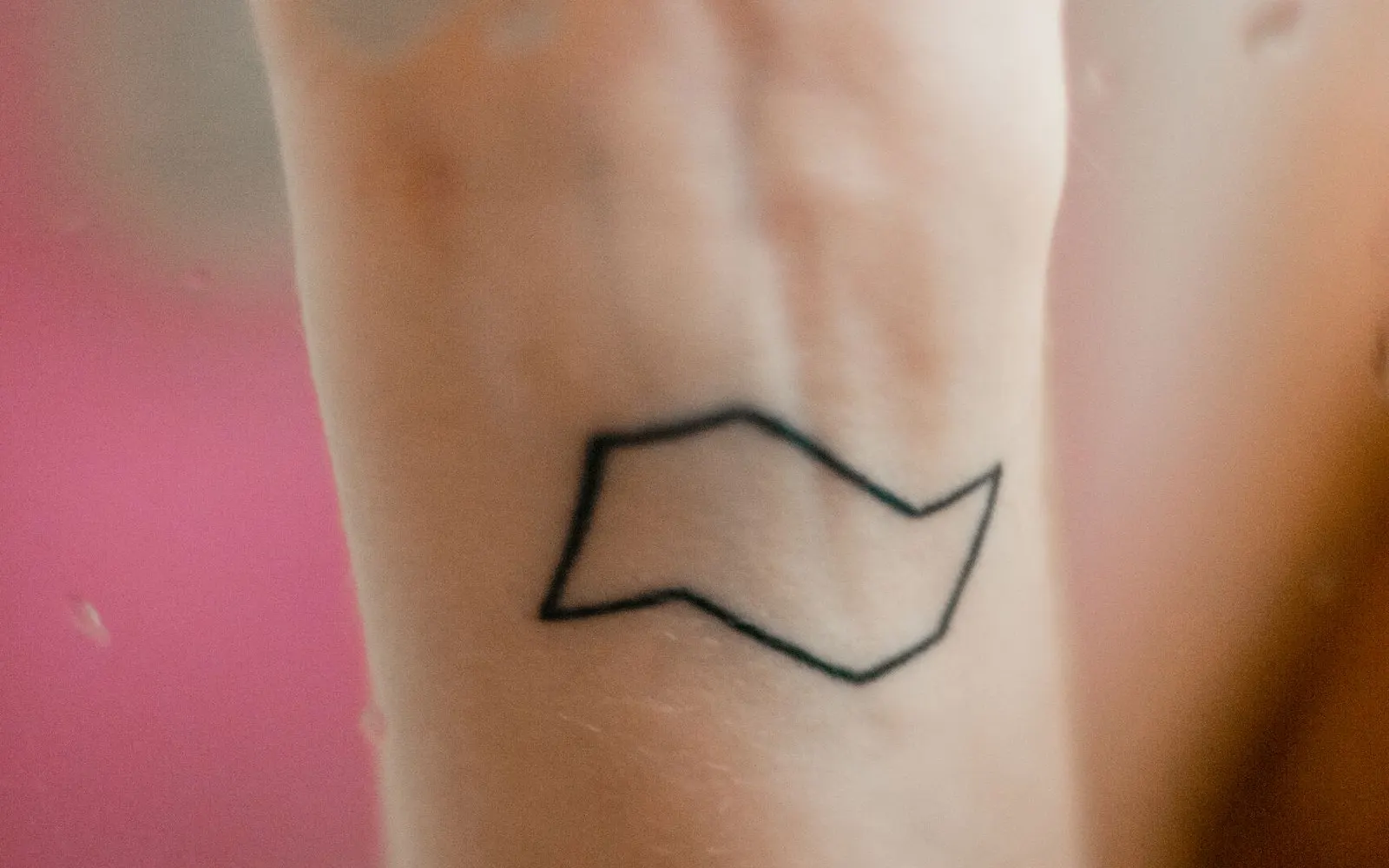
This one is a good reason not to take any of this as gospel. Finger tattoos are generally expected to be slower, but this one has responded really well over four sessions and is fading faster than I would have predicted from location alone.
Research like this gives me a better starting point, but it can’t tell me exactly what your tattoo is going to do.
I see tattoos break the “rules” all the time.
So what does this change for me?
Mostly, it changes the conversation. If someone comes in with a tattoo on their ankle or foot, I’ll generally be more cautious about how quickly I expect it to fade. If it’s on their shoulder, chest or back, I might expect it to move a bit quicker.
But I’m still looking at everything else as well: how much ink is there, what colours are in it, how deep it is, whether there is any scarring, whether it has been treated before and how the skin responds after the first session.
Two tattoos in exactly the same place can still behave completely differently, which is why I give a realistic range instead of promising a number.
References
- 1.Menashe S, Moscovici S, Dor O, Govrin Y, Kapxhiu G, Avdulaj A. Removal of Artistic and Cosmetic Tattoos Using Q-Switched Nd:YAG Laser. Journal of Cosmetic Dermatology. 2026;25(7):e71038. doi:10.1111/jocd.71038The study this guide is about: a look back through the treatment records of 111 adults at several clinics.
- 2.Bencini PL, Cazzaniga S, Tourlaki A, Galimberti MG, Naldi L. Removal of Tattoos by Q-Switched Laser: Variables Influencing Outcome and Sequelae in a Large Cohort of Treated Patients. Archives of Dermatology. 2012;148(12):1364–1369. doi:10.1001/archdermatol.2012.2946An earlier study of what was linked with better and worse results in patients treated with the same kind of laser.
- 3.Kirby W, Desai A, Desai T, Kartono F, Geeta P. The Kirby-Desai Scale: A Proposed Scale to Assess Tattoo-removal Treatments. The Journal of Clinical and Aesthetic Dermatology. 2009;2(3):32–37. Read the source · PubMedThe scoring system behind our session calculator.
Keep reading
Treatment expectations
How Many Sessions Does Laser Tattoo Removal Take?
In the largest study, under half of tattoos were fully gone after ten sessions and three quarters after fifteen. I explain what moves your number, and why I only ever give a range.
Reviewed · 3 min readRead →

Treatment expectations
Does Smoking Affect Laser Tattoo Removal?
Smoking is the one lifestyle habit anyone has measured in tattoo removal, and smokers were less likely to have their tattoo fully gone. If you smoke and I’m treating you, this is what it means.
Reviewed · 3 min readRead →